
Ginger Blight Epidemic in Nigeria: Farmers’ Nightmare, How Far So Far
-
Ijeoma Adaku Nnebechukwu


Department of Plant Science and Biotechnology, University of Jos, Jos, Nigeria
Amabel Miracle Sumi-LotDepartment of Plant Science and Biotechnology, Plateau State University, Bokkos, Nigeria
Margaret Musa AtsenDanladiDepartment of Microbiology, Plateau State University, Bokkos, Nigeria
| Received 19 Aug, 2026 |
Accepted 23 Oct, 2026 |
Published 10 Nov, 2026 |
Ginger (Zingiber officinale Roscoe) is a high-value spice crop grown in several states across Nigeria, including Kano, Benue, Plateau, Bauchi, Nasarawa and Southern Kaduna State- the traditional home of ginger in Nigeria and accounts for about 85% of the country’s total production. Ginger is rich in bioactive compounds and is widely utilized in several cuisines and industries. To improve Nigeria’s foreign exchange profits and foster domestic trade for the populace, its production was increased. However, ginger production has been severely threatened by the outbreak and recurrence of ginger blight disease, as well as other diseases caused by other microorganisms a destructive rhizome rot primarily caused by Fusarium species. This review provides a thorough overview of ginger blight disease in Nigeria, combining recent economic analysis and government interventions and highlights the potential of biotechnological approaches, including spray-induced gene silencing, molecular diagnostics, tissue culture-based production of disease-free planting materials, biological control, and genetic improvement as sustainable solutions and eco-friendly alternatives for long-term disease management.
INTRODUCTION
Ginger (Zingiber officinale Roscoe) is an herbaceous and perennial plant that belongs to the family Zingiberaceae and has been cultivated over time based on history1,2. Several states in Nigeria are known to grow ginger extensively as a significant export commodity, generating revenue for the nation. States like Kaduna, Plateau, Bauchi, Benue, Gombe, Abuja, and Nasarawa are frequent ginger-producing areas. Because of its high oleoresin content and reputation for being especially powerful, Nigerian ginger is the most preferred kind internationally and is used in several dishes and medicines2. Recently, ginger and its products (gingerbread, ginger cake, ginger coffee, ginger drink, ginger oil, ginger spice, ginger syrup, and ginger wine) have become increasingly popular in households, pharmaceuticals, breweries, cuisines, and other related industries3 Nigeria’s principal export destinations for ginger include Dubai, where farmers mostly sell to foreign traders, and South Africa, India, and Morocco, where it is sold directly to local food processing industries.
The ginger plant grows about three to four feet (0.9 to 1.2 meters) tall, with thin, sharp leaves that are six to twelve inches long4. The ginger itself is a branched, scarlet brownish/beige root or rhizome, and as it grows, it has white and pink buds that blossom into yellow flowers that grow in dense spikes. The rhizome is often fragrant and has a strong, sharp flavor. Ginger grows at a range of 50 to 100 cm in height having a rhizome that can vary in shape and size depending on the cultivar It can range in length from one to six inches5. The hue of ginger’s flesh varies from ivory to a light greenish yellow.
Ginger contains 50% starch, 9% protein, 6-8% lipids, 2% protease, 1-3% nonvolatile oils which is responsible for its pungent smell and taste, it also contains nutrients and bioactive compounds such as proteins, carbohydrates, alkaloids, tannin, saponnin flavonoids, steriods terpenoids, phenols, anthraquinone glycosides, cardiac glycosides, glycosides and flavonoids6 which are important for proper functioning of the body.
Consumed either fresh or dried and acts as a spice to add flavor and taste to food. Additionally, it is used in the brewery industry to produce drinks, in confectionery items, pickles, sauces and as preservatives7. Ginger leaf has also been utilized, particularly in China, in traditional medicine and food flavoring8. It has long been used in herbal medicine to treat a variety of symptoms, such as nausea, pain, and cold symptoms9. It contains gingerol, which has potent medicinal qualities and can be used to prevent some types of cancer. It also aids in digestion, has anti-inflammatory and antioxidant effects, and, according to research, helps with osteoarthritis, which is the degeneration of joints in the body10. It also lowers blood sugar and heart disease risk factors, lowers cholesterol, improves brain function, and guards against Alzheimer’ disease. In addition to its anti-clotting properties, ginger can be utilized to prevent a number of heart conditions.
Ginger production is constrained by a range of environmental (abiotic) conditions as well as biological (biotic) constraints. The principal biological threats include; bacteria, fungi, viruses and plant-parasitic nematodes. Many microbial species cause agriculturally related infections including fungal infections such as soft rot11. Fungal infections also pose a significant threat in ginger, causing rhizome rot, soft rot, Sclerotium rot, and yellows disorder. Futhermore, nematodes cause root knot disease in ginger plants,, whereas viruses create mosaic and chlorotic fleck. Ultimately, these disease factors significantly lower rhizome development and yield12. The objective of this review is to summarize the current status of the ginger blight epidemic in Nigeria, examine its causes, epidemiology, and socioeconomic impacts on ginger production, evaluate existing disease management strategies, and identify knowledge gaps and future directions for sustainable control and recovery of the ginger industry.
GINGER PRODUCTION IN NIGERIA
According to Ewuziem et al.13, Nigeria is one of the world’s top producers of ginger after China, Thailand among other countries. The large arable land makes it suitable for the crop’s cultivation in Kaduna, with so much links within the value chain from the producers to the processors14. Despite these natural benefits, the nation may lose its position as a global leader in ginger production due to a variety of problems, such as poor pest control, seed scarcity, unpredictable weather patterns brought on by climate change.
Nigeria has continued to face negative effects of ginger production as a result of diseases of which some of the causative agents have been identified15. This outbreak affected more than 30,000 hectares of farmland leading to a significant decline in production. Many farmers, unable to cope with rising production costs and repeated crop failures, are abandoning ginger cultivation altogether, switching to crops like maize, beans, cassava, or turmeric. This abandonment threatens to prolong the crisis into future growing seasons.
Additionally, a significant portion of the scarce ginger produced is still exported due to weak control regulations, further restricting local supply. Despite a 74% decline in Nigeria’s ginger exports in 2024, local markets are still underserved because of continuous demand from outside sources. Farmers frequently find it difficult to obtain high-quality seedlings, fertilizer, and equipment during the input supply stage, and the high cost and subpar quality of these inputs continue to limit ginger farmers’ productivity and earnings.
Smallholder farmers are mostly responsible for primary post-harvest operations which include washing, slicing, and drying after harvest. While the secondary processing stage, which entails converting ginger into goods like powder, essential oils, and confectionery items, is often handled by big businesses outside of Nigeria due the absence of industrial processing in the country. This lack results in a loss of value and income for the nation.
DISEASE OVERVIEW
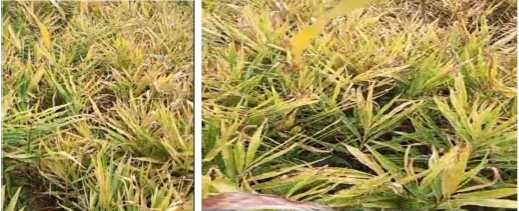
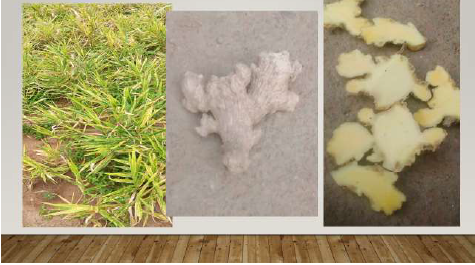
The abrupt yellowing and drying of ginger leaves is a defining feature of ginger blight disease (Fig. 1), sometimes referred to as tuber rot disease. This epidemic causes the rhizomes of the plant to decompose in the soil (Fig. 2). The infection mostly damages underground tubers, causing them to turn brown and rot, while the afflicted area discharges a clear liquid. As the disease advances, white mycelium causes the infected plant’s aerial parts to wither. Contaminated seed rhizomes and inadequately decomposed manure also serve as major inoculum sources. Damp environments favors the pathogens growth, which are favorable for blight disease, particularly in low-lying areas, thick soil, and poor drainage. Spores (conidia) formed on infected tissues are readily dispersed by splashing rain or irrigation water, facilitating secondary spread. Disease is a risk when unmatured manure is applied or crops are grown continuously. The symptoms of ginger blight and ginger soft rot, two significant fungal infections that harm ginger tubers, are comparable. These diseases obviously causes ginger to soften and develops into soft rot disease which is caused by an array of microorganisms16. Under humid conditions, some white mycelia similar to wet cotton may appear on infected tissues.
EPIDEMIOLOGY IN NIGERIA
Emergence and spread: An outbreak of ginger blight occurred in May and June of 2023, since then research has been conducted on the cause of the disease especially in the main hub of production; Kaduna, reports have shown that many fungal species were associated with this devastating disease associated with Nigerian ginger, ginger diseases can lead to huge losses because of lower quality and yield17,18. Reports indicate that the disease spread swiftly in eight local government areas in southern Kaduna as indicated by yellowing and drying of ginger leaves leaves (Fig. 1), there has been reports of visible discolouration of the rhizome19 which can also be seen in the tissue damage in the cut rhizome from the farms as indicated in (Fig. 2). Fig. 1, causing production . Beyond field losses, this outbreak created a significant shortage of viable planting materials due to a narrow gene pool, making it challenging for farmers to replant and maintain agriculture because of reliance on very few varieties of ginger20. Due to the scarcity, demand has reached an all-time high, driving seed prices upward. Production costs of ginger have also increased as a result of rising seed, fertilizer, and fungicide prices which has also been reported in a study21. Additionally, insecurity that has been exacerbated by threats from kidnappers and bandits in key farming communities has further constrained agricultural activities and has also discouraged farming activities, disrupting the entire agricultural supply chain including ginger22.
Reocurrence and resurgence: In 2025, ginger farmers expressed concerns over the re-emergence of ginger blight disease that devastated their farms in 2023, leading to a loss estimated at 12 billion naira18,23.
For more two decades, after each harvest, a significant proportion of seeds often replanted by farmers in the country are seeds that are susceptible to infection. This continuous recycling of disease-prone seeds likely contributes to the persistent and recurrent outbreaks of diseases faced in ginger production systems.
|
|
Some farmers who failed to apply any form of chemical on their farms due to unavailability or the high cost of the chemicals faced severe loss of their ginger crops. However, in another report by Ezima et al.23, it was also noted that some farmers who used chemicals continued to suffer losses as a result of the disease. The main constraint in ginger cultivation and other root vegetables and production are as a result of poor processing and fungal infestation24 which will significantly affect Nigeria’s position as a leading global ginger producer among other crops.
SOCIOECONOMIC IMPACT
According to foreign trade data from the National Bureau of Statistics (NBS), Nigeria’s ginger exports fell 74% from N23.76 billion in the same time in 2023 to N6.28 billion in the first nine months of 2024. The current outlook remains highly concerning, and without decisive intervention, further deterioration is likely. According to reports by Tanko et al.25 the cost of agricultural produce including ginger increased significantly.
The effect of the the dwindling performance of agricultural produce, including ginger, Nigeria’s agricultural sector fails to capitalize on high-demand international markets, leading to underutilized trade potential and reduced economic potential26. Ginger is an important cash crop and a substantial source of revenue for smallholder farmers in Nigeria, making the country one of the world’s top producers of the vegetables27. The president of the Ginger Growers, Processors and Marketers
Association of Nigeria (GGPMAN) stated that the disease outbreak devastating farms is the reason why exports of the commodity are decreasing. Reports have indicated that the disease caused by ginger which is monitored by human visualization is not reliable and can still not tackle the future outbreaks, the use of new technology models such as machine learning could be of help28.
CURRENT MANAGEMENT AND GOVERNMENT RESPONSE
The National Ginger Blight Epidemic Control Taskforce was created by the Federal Government of Nigeria in reaction to the outbreak with the goal of coordinating integral ted efforts to limit the disease, assist impacted farmers, and prevent future outbreaks. sIn order to revitalize the ginger farming industry in Nigeria, the Federal Government of Nigeria launched the Ginger Recovery Advancement and Transformation for Economic Empowerment (GRATE) initiative in October 2023 under the auspices of the National Agricultural Development Fund (NADFund). Government funding since not adequate to support ginger farmers across the country, a study suggested the strengthening of market access, youths’ inclusion through better market linkages, entrepreneurship development, skills training, and youth-friendly funding opportunities29. In an effort to provide some reprieve, farmers in a number of important ginger-growing states have also received agrochemicals such as pesticides and fungicides. Despite these measures to curb the infection, many farmers, especially in Kaduna and Kano, the two main ginger growers, continue to experience substantial production setbacks due to rising insecurities22 and continues occurrence of diseases. According to agricultural experts, sustainable recovery will depend more on the development and distribution of disease-resistant planting materials rather than on increased reliance on chemical control measures.
KNOWLEDGE GAPS AND RESEARCH NEEDS
One key research gap is the ability to promptly identify and combat the causative agents of ginger blight disease using biotechnology and associated epidemiological dynamics in Nigeria’s distinct agroecological zones. There is limited in depth scientific research on long term solutions to the fungal strains. A large amount of information available is focused on the losses caused by the disease since its emergence in Nigeria, where it wiped out about 90 per cent of ginger crops in affected areas in 2023. Researchers and other institutions need to be strategic in solving the menace of ginger diseases to avert future occurrences and ensure a steady contribution to the agricultural value chain. Several reports from farmers indicate that chemicals used to combat ginger blight disease merely suppress the disease rather than completely eradicating it. Furthermore, some fungal strains have shown resistance to fungicides or combined treatments leading to negative effects in the agricultural space, even though combined treatments has shown some level of success which is not adequate11.
An alternative for synthetic fungicides will be the use of several biological control, including T. harzianum and plant isolates, which are thought to be environmentally friendly and sustainable. Also, biotechnological techniques such as tissue culture and genetic engineering can be utilized to develop disease resistant varieties and high value cultivars30. More research will need to be carried out to understand the root cause and find a permanent solution.
BIOTECHNOLOGICAL APPROACHES FOR THE MANAGEMENT OF GINGER BLIGHT DISEASE IN NIGERIA
Biotechnology provides strong and sustainable solutions to address the current ginger blight epidemic in Nigeria by combating the disease at molecular, genetic, microbial, and diagnostic levels30. Biotechnological tools such as micropropagation have utilized in improving plant species. In vitro generation of haploids, somatic embryogenesis, somatic hybridization, germplasm preservation and storage, recombinant DNA technology, RNAi Biofungicides produced using dsRNA, Spray-Induced Gene Silencing and transgenics offer promising solution to managing disease infestation in crops31. Integrating modern plant biotechnology into ginger production systems can greatly lower the diseases incidences, increase productivity, and restore farmers’ confidence.
One major obstacle to managing ginger blight disease in Nigeria is the late diagnosis of infection, frequently after significant rhizome damage has occurred. Molecular diagnosis and early disease detection, the creation of disease-resistant ginger varieties, the creation of disease-free planting material using tissue culture methods, and genetic transformation are all possible with biotechnology32. Biotechnology can also facilitate whole-genome sequencing of pathogenic fungi to identify virulence factors. Continuous recycling of infected rhizomes has contributed significantly to the spread of ginger blight in Nigeria; exploring these biotechnological techniques will reduce reliance on contaminated farm-saved seeds and boost ginger production.
For biotechnology to be effective, institutional support is critical:
| • | Establishment of plant biotechnology laboratories in ginger-producing regions | |
| • | Training of researchers, extension agents, and farmers in biotechnological applications | |
| • | Integration of biotechnology into national ginger recovery and biosecurity policies | |
| • | Promotion of public-private partnerships to scale innovations | |
| • | Until these issues are addressed, ginger prices will likely remain high, affecting not just home cooks and herbal vendors, but also businesses in the food, wellness, and export sectors | |
| • | Without widespread access to disease-resistant seeds, affordable inputs, and institutional support, the situation remains bleak |
To stabilize ginger availability and prices, Nigeria must:
| • | Establish and fund biotechnology laboratories to rapidly produce disease-resistant seeds, which will be distributed to farmers | |
| • | Provide financial support and training in disease management | |
| • | Invest in long-term agricultural infrastructure and research |
CONCLUSION
The ginger blight epidemic in Nigeria stands as a strong reminder of the vulnerabilities that exist within informal seed systems, weak plant health infrastructure, and insufficient disease management practices. A holistic, integrated approach to addressing these interconnected challenges is essential for unlocking the full potential of the ginger industry. Although government responses and recovery interventions have provided short-term relief, long-term success will depend on coordinated research efforts, reinforced biosecurity measures, and the development of disease-resistant ginger varieties. The application of biotechnology offers a potential sustainable, and a long-lasting solution to ginger blight disease in Nigeria. Strategic investments in diagnostics, resistant varieties, tissue culture, and microbial control will not only mitigate current outbreaks but also safeguard Nigeria’s ginger industry against future epidemics. Strengthening Nigeria’s ginger value chain is not only essential for farmer livelihoods but also for preserving the country’s position in international spice markets.
SIGNIFICANCE STATEMENT
Ginger is one of Nigeria’s most important spice crops and a major source of income for thousands of farming households, particularly in Southern Kaduna. In recent years, ginger production has been severely threatened by a devastating plant disease known as ginger blight, which has destroyed farms, reduced exports, and increased food prices. This review explains the causes and consequences of the ginger blight epidemic in Nigeria in simple terms, highlighting how it affects farmers, consumers, and the national economy. It also discusses current government responses and outlines how modern biotechnology, such as improved disease detection, clean planting materials, and resistant varieties, can help protect ginger production in the long term. Understanding and addressing this crisis is essential for food security, farmer livelihoods, and Nigeria’s position in the global spice market.
ACKNOWLEDGMENT
The authors gratefully acknowledge the various published articles, books, and online resources consulted for the materials and information used in this review.
REFERENCES
- Zhang, M., R. Zhao, D. Wang, L. Wang and Q. Zhang et al., 2021. Ginger (Zingiber officinale Rosc.) and its bioactive components are potential resources for health beneficial agents. Phytother. Res., 35: 711-742.
- Edo, G.I., U.A. Igbuku, R.S. Makia, E.F. Isoje and T.S. Gaaz et al., 2025. Phytochemical profile, therapeutic potentials, nutritional composition, and food applications of ginger: A comprehensive review. Discover Food, 5.
- Shaukat, M.N., A. Nazir and B. Fallico, 2023. Ginger bioactives: A comprehensive review of health benefits and potential food applications. Antioxidants, 12.
- Swamy, K.R.M., 2024. Origin, distribution, taxonomy, botanical description, genetics and cytogenetics, genetic diversity and breeding of ginger. Int. J. Curr. Res., 16: 29179-29201.
- Zhang, S., X. Kou, H. Zhao, K.K. Mak, M.K. Balijepalli and M.R. Pichika, 2022. Zingiber officinale var. rubrum: Red ginger’s medicinal uses. Molecules, 27.
- Edo, G.I., U. Ugbune, F.O. Onoharigho, G.O. Ezekiel, E. Ugbuwe and J.J. Agbo, 2023. Investigation of the metal complexes and bioactive compound formed by coordination of bioactive phytochemical from ginger (Zingiber officinale) extracts to metal ions. Food Chem. Adv., 3.
- Bag, B.B., 2018. Ginger processing in India (Zingiber officinale): A review. Int. J. Curr. Microbiol. Appl. Sci., 7: 1639-1651.
- Shahrajabian, M.H., W. Sun and Q. Cheng, 2019. Clinical aspects and health benefits of ginger (Zingiber officinale) in both traditional Chinese medicine and modern industry. Acta Agric. Scand. Sect. B: Soil Plant Sci., 69: 546-556.
- Crichton, M., S. Marshall, W. Marx, A.L. McCarthy and E. Isenring, 2019. Efficacy of ginger (Zingiber officinale) in ameliorating chemotherapy-induced nausea and vomiting and chemotherapy-related outcomes: A systematic review update and meta-analysis. J. Acad. Nutr. Diet., 119: 2055-2068.
- Kiyama, R., 2020. Nutritional implications of ginger: Chemistry, biological activities and signaling pathways. J. Nutr. Biochem., 86.
- Sharma, S., N.P. Dohroo, S. Veerubommu, S. Phurailatpam, N. Thakur and A.N. Yadav, 2017. Integrated disease management of storage rot of ginger (Zingiber officinale) caused by Fusarium sp. in Himachal Pradesh, India. Int. J. Curr. Microbiol. Appl. Sci., 6: 3580-3592.
- Meenu, G. and T. Jebasingh, 2020. Diseases of Ginger. In: Ginger Cultivation and its Antimicrobial and Pharmacological Potentials, Wang, H. (Ed.), IntechOpen, London, United Kingdom, ISBN: 978-1-83880-407-7.
- Ewuziem, J.E., V.O. Onyenobi, A.G. Ironkwe and M.H. Tokula, 2016. Nigeria in world ginger trade: An analysis of performance from 2008-2012. J. Agric. Food Sci., 13: 26-42.
- Abdullahi, S., M. Garba, A.U. Babaji and K. Wisdom, 2025. Factors influencing the adoption of ginger production technologies in Southern Kaduna, Kaduna State Nigeria. J. Agripreneurship Sustainable Dev., 8: 7-14.
- Moses, B.E., E.C. Egwim, M.A. Ibrahim, P. Waziri, P.U. Dogara and S. Abubakar, 2026. Isolation, morphological and molecular identification of fungal pathogens associated with diseased ginger (Zingiber officinale Roscoe) in Southern Kaduna, Nigeria. Trop. J. Nat. Prod. Res., 10: 11308-11315.
- Huang, K., X. Sun, Y. Zou, H. Li and P. Xu et al., 2022. Comparison of the endophytic bacterial microbiota of asymptomatic and symptomatic ginger rhizomes during the activation of adventitious bud development. Plant Dis., 106: 2470-2479.
- Akos, I.S., J. Clement, J. Maiangwa and E.D. Shamaki, 2026. Determination of susceptibility patterns of ginger (Zingiber officinale roscoe) genotypes to epidemic diseases in Kaduna State, Southern Guinea Savanna, Nigeria. Sci. World J., 20: 1384-1392.
- Dohroo, N.P., 2016. Diseases of Ginger. In: Ginger: The Genus Zingiber, Ravindran, P.N. and K.N. Babu (Eds.), CRC Press, Boca Raton, Florida, ISBN: 9780429120770, pp: 325-360.
- Kumar, A., 2023. Diseases of Ginger and Turmeric. In: Handbook of Spices in India: 75 Years of Research and Development, Ravindran, P.N., K. Sivaraman, S. Devasahayam and K.N. Babu, Springer Nature, Singapore, ISBN: 978-981-19-3728-6, pp: 3675-3707.
- Ayodele, T.J. and B.E. Sambo, 2014. Ginger (Zingiber officinale roscoe) production efficiency and constraints among small scale farmers in Southern Kaduna, Nigeria. J. Agric. Sci., 6: 141-148.
- Adhikari, A. and T. Bhandari, 2022. Socio-economic analysis of ginger production in Terhathum District, Province no. 1, Nepal. Arch. Agric. Environ. Sci., 7: 61-69.
- Yusuf, A., M. Abdullahi and M.M. Abdullahi, 2025. Security threats and agricultural productivity: Farmers' and community leaders' views on kidnapping and banditry in Zamfara State, Nigeria. Aefunai J. Econ. Finance Dev. Stud., 2: 100-119.
- Ezima, N., A. Amaefula, J.O. Nwaekpe, H.N. Anyaegbunam and B.C. Okoye, 2024. Effectiveness and cost-benefit analysis of different disease control measures for smallholder ginger farmers in Kaduna State. Nigeria Agric. J., 55: 1214-1226.
- Ajayi, E.O., P.E. Akin-Idowu, O.R. Aderibigbe, D.O. Ibitoye and G. Afolayan et al., 2022. Nigeria Root Vegetables: Production, Utilization, Breeding, Biotechnology and Constraints. In: Advances in Root Vegetables Research, Kaushik, P. (Ed.), IntechOpen, London, United Kingdom, ISBN: 978-1-80356-703-7.
- Tanko, F., F.D. Ibrahim, E.S. Yisa and O.A. Ojo, 2023. Price and output trend of ginger in Nigeria for the period 1990-2020. J. Agripreneurship Sustainable Dev., 6: 39-46.
- Akinyode, A.E., M.O. Raufu, M.O. Adetunji and J.O. Olalere, 2025. Trend and trade potentials of ginger export in Nigeria. Int. J. Agric. Econ. Rural Dev., 15: 129-135.
- Salau, S.A. and A.J. Afniki, 2023. Economics of ginger production in the Federal Capital Territory, Abuja, Nigeria. Fuoye J. Agric. Human Ecol., 7: 50-59.
- Saleem, M.H., J. Potgieter and K.M. Arif, 2019. Plant disease detection and classification by deep learning. Plants, 8.
- Alim, S.A., N. Murtala, S. Abdurrahman and S.A. Jibril, 2026. Analysis of effect of ginger value chain on poverty reduction in Kaduna State, Nigeria. Niger. J. Agric. Agric. Technol., 6: 404-412.
- Elijah, O., A.E. Abioye and T.E. Maguvu, 2025. Pest and disease management in ginger plants: Artificial intelligence of things (AIoT). IEEE Trans. Agrifood Electron., 3: 86-97.
- Nnebechukwu, I.A., U.C. Ohaeri, D.M.M. Atsen, S.L.A. Miracle and G.D. Abraham, 2026. Ecological safety of RNAi biofungicides: Assessing the impact of spray-induced gene silencing on the indigenous phyllosphere microbiome of tropical staples. Plant Sci. Rev., 7: 1-4.
- Pandey, H., V. Misra, A. Sharma, B. Chatterjee and M. Sutradhar et al., 2025. Interventions of plant tissue culture techniques and genome editing in medicinally important spice crops. Med. Plant Biol., 4.
How to Cite this paper?
APA-7 Style
Nnebechukwu, I. A., Sumi-Lot, A. M., & AtsenDanladi, M. M. (2026). Ginger blight epidemic in nigeria: Farmers’ nightmare, how far so far. Asian Journal of Plant Pathology, 20(1), 55–62. https://doi.org/10.3923/ajpp.2026.55.62
ACS Style
Nnebechukwu, I. A.; Sumi-Lot, A. M.; AtsenDanladi, M. M. Ginger Blight Epidemic in Nigeria: Farmers’ Nightmare, How Far So Far. Asian J. Plant Pathol. 2026, 20 (1), 55–62. https://doi.org/10.3923/ajpp.2026.55.62
AMA Style
Nnebechukwu IA, Sumi-Lot AM, AtsenDanladi MM. Ginger blight epidemic in nigeria: farmers’ nightmare, how far so far. Asian Journal of Plant Pathology. 2026;20(1):55–62. doi:10.3923/ajpp.2026.55.62
Chicago/Turabian Style
Nnebechukwu, Ijeoma Adaku, Amabel Miracle Sumi-Lot, and Margaret Musa AtsenDanladi. 2026. “Ginger Blight Epidemic in Nigeria: Farmers’ Nightmare, How Far So Far.” Asian Journal of Plant Pathology 20 (1): 55–62. https://doi.org/10.3923/ajpp.2026.55.62

This work is licensed under a Creative Commons Attribution 4.0 International License.