
Biocontrol of Botrytis cinerea on Tomato Leaves and Growth Promotion Potential of Soil Isolate HJ505 (Burkholderia ambifaria)
-
Gasta Mouka Adechina Adam Dade

The United Graduate School of Agricultural Sciences, Tottori University, Koyama-Minami 4-101, Tottori 680-8553, Japan
Makoto UenoLaboratory of Plant Pathology, Faculty of Life and Environment Sciences, Shimane University, Matsue 1060, Shimane 690-8504, Japan
| Received 03 Mar, 2026 |
Accepted 03 Jul, 2026 |
Published 30 Jul, 2026 |
Background and Objective: Due to the warm and humid weather in glasshouse or open field in West-Africa, tomato culture is exposed to phytopathogens like Botrytis cinerea causing tomato seedlings damping-off, leaves lesions and fruits rot. In this study, Japan soil bacteria HJ505 was evaluated for Botrytis cinerea biocontrol and tomato growth promotion. Materials and Methods: Dual culture technic was used to evaluate HJ505 inhibitory effect on various pathogens, and microscopy counting used for Botrytis cinerea conidia inhibition. Spray technic was used for home Momotaro tomato leaves inoculation, 16S rDNA analyzed for HJ505 identification, disc diffusion used for protease and siderophores production test. HJ505 cells were observed on electron microscopy and volatile compounds production evaluated on divided sealed plates. IAA production by HJ505 was tested using colorimetric method, and broth poisoning technic was used for salinity and acidity tolerance test. Statistical analysis was performed using Student’s t-test (two groups), one-way ANOVA followed by Tukey’s HSD test (multiple groups), with data presented as Mean±SD and significance considered at p<0.05 Results: Isolate HJ505 PC1 broth strongly inhibited on plates Botrytis cinerea and 5 others tomato fungal pathogens. HJ505 LB broth and filtrate inhibitory effect on pathogen conidial germination were also confirmed. On tomato plants, HJ505 LB broth and filtrate significantly reduced pathogen Botrytis cinerea necrotic lesions on leaves. HJ505, identified as Burkholderia ambifaria, shared the rod shape of Burkholderia species cells, produced protease and volatile compounds. HJ505 promoted tomato seedling growth, produced siderophores, IAA and was tolerant to pH and salinity variation. Conclusion: HJ505 can be considered as a good candidate for Botrytis cinerea biocontrol and tomato growth promotion.
INTRODUCTION
Tomato is a vegetable fruit well known in the world and was reported in 2023 as world most harvested vegetable fruit with a production up to 192 millions of tones1. Tomato is present in many diets around the world especially in Western Africa countries. In a country like Nigeria, tomato is presented as an important diet heritage and its consumption among a household of seven is estimated at 187 kg per year2,3. The organisation of local tomato production to meet consumers’ high demand has ranked Nigeria as 11th in the world and 2nd tomato largest producer in Africa3. However, the threat posed by climate change to the traditional open-field cultivation of tomato in terms of productivity decrease, and susceptibility to pests and diseases, has led to the recommendation of tomato cultivation in controlled conditions such as greenhouse in Nigeria4. Another similar suggestion has also been made in Ghana Republic, a neighboring country, confirming the increase of greenhouse tomato production in a near future in West-Africas5. Tomato cultivation in general is exposed to many phytopathogens and under greenhouse tomato gray mold caused by Botrytis cinerea is well known as big threat to tomato plants but also to the fruits after being harvested6. In Burkina-Faso, another West-African tomato-producing country, Botrytis cinerea was reported among many others tomato fungal pathogens associated to tomato diseases7 confirming the presence and the threat of the pathogen in West-Africa. Botrytis cinerea is a necrotrophic fungus mainly characterized by its genetic variability and its ability to easily adapt to the environment8,9. It was reported infecting various fruits and vegetables like tomato, apple and strawberry10-12. To control Botrytis cinerea, the use of bacterial biocontrol agents is a sustainable alternative to reduce reliance on chemical pesticides, especially in West Africa, where many phytosanitary chemicals used in agriculture are reported to be harmful to humans and the natural ecosystem 13. Bulkhoderia species are gram-negative13,14 and some are plant pathogens such as Bulkhoderia plantarii and Bulkhoderia glumae15. Some are able to infect animals and humans like Bulkhoderia mallei and Bulkhoderia. pseudomallei16. Bulkhoderia ambifaria used in this study as biocontrol agent, has been reported to inhibit plant pathogens through enzymes and secondary metabolites17,18. However inhibitory effect of Bulkhoderia ambifaria on tomato leaves infected by Botrytis cinerea has not yet been demonstrated. Among Bulkhoderia species, Burkholderia gladioli strain KRS027 has been reported inhibiting Botrytis cinerea gray mold on tobacco leaves, but not yet on tomato leaves19. In this study, Shimane prefecture soil isolated microbe HJ505 will be evaluated against pathogen Botrytis cinerea on home Momotaro tomato cultivar (cv.) and also for its growth promotion.
MATERIALS AND METHODS
Study area and duration: The study was conducted from January 2022 to March 2023 in the Plant Pathology Laboratory (in vitro and in planta experiment) and Honjo experimental farm (soil microbes isolation) of Shimane University. Both area are located in Matsue city of Shimane prefecture, Southwest Japan.
Plant and pathogens: Home Momotaro tomato cultivar (cv.) seedlings were selected for this experiment and were grown as described by Adam Dade et al.20. At 21 days old, seedlings were used in the same pot for plant experiments in a growth chamber under a temperature of 26±2°C and 70 % of relative humidity.
Pathogen Botrytis cinerea strain MAFF243092 was obtained from the Japan NARO Genebank and was preserved on potato sucrose agar (PSA; 200 g/L potatoes, 2.0% w/v sucrose, 2.0% w/v agar) slants. A diameter of 6 mm mycelial disc was placed on the center of potato dextrose agar (PDA; 200 g/L potatoes, 2.0% w/v dextrose, 2.0% w/v agar) plates at 20±2°C in the glass incubator without light for 3 days and then placed for 7 days under near-ultraviolet radiation provided by fluorescent lamps (FL20S/BLB; Panasonic, Osaka, Japan) at 26±2°C for sporulation. Asexual spores or conidia were collected by pouring 5 mL of sterile distilled water (SDW) onto sporulated PDA culture and gently scratching the conidia into a 10 mL glass beaker with a sterilized spoon spatula. Mycelial solution is then filtered using a 90 mm filter paper (Advantech), and the concentration was fixed to approximately 3×10⁶ conidia/mL with a hemocytometer for use. To produce mycelia without sporulation, PDA plates with mycelial disc placed at the center, are kept in the incubation room at 26±2°C in the dark for 14 days.
HJ505 isolation and culture: In this study, four soil samples (HJ1, HJ2, HJ3 and HJ4) were randomly collected from a field on Honjo experimental farm previously used to grow strawberry. From the four soil samples, 100 microorganisms were isolated using a modified method of Lemtukei et al.21. A little amount of collected soil samples was placed in a micro tube with 1 mL of distilled water (DW). From each sample 20 μL was spread on humid vitamin acid agar (HVA; 0.1% w/v humic acid, 0.05% w/v Na2HPO4, 0.17% KCl, 0.001% w/v MgSO4 7H2O, 0.001% w/v FeSO 7H2O, 0.002% w/v CaCO, 1.8% w/v agar and 0.1% v/v of vitamin solution after autoclave). The same amount was also spread on tryptic soy agar (TSA; 1.5% w/v casein pancreatic digest, 0.5% w/v soybean peptic digest, 0.5% w/v NaCl, 1.5% w/v agar). After autoclave, 1% w/v of each cycloheximide and nalidixic acid was added to both medium. All petri plates were incubated for 4 days at 26±2°C. A single colony of HJ505 obtained from both inoculated HVA and TSA media was picked and reinoculated on nutrient broth glucose agar (NGA; 2% w/v nutrient broth, 1% w/v glucose and 1% w/v agar) for 4 days at 26±2°C. Distinct colonies on NGA medium were inoculated into test tubes containing 3 mL of PC1 broth (1 % w/v of each starch, polypeptone, molasses, beef extract at a pH of 7.2). Tubes were then incubated at 180 round per minute (rpm) on a rotary shaker for 7 days at 26±2°C. Isolated microorganisms were suspended in 15-20% glycerol solution and stored at -80°C until being used for Botrytis cinerea mycelial growth inhibition screening. For its use, isolate HJ505 glycerol was grown on lysogeny broth agar (LBA; 0.5% w/v yeast extract, 1% w/v bactotryptone, 1% w/v NaCl, 2% w/v agar) and incubated for 3 days at 28±2°C. Colonies were inoculated into culture tubes containing either 5 mL of PC1 or 5 mL of lysogeny broth (LB; 0.5% w/v yeast extract, 1% w/v bactotryptone, 1% w/v NaCl). The culture tubes were incubated at 26±2°C for 3 days at 180 rpm and ready for use. For all experiments, HJ505 PC1 and LB broth with an optical density (OD600nm)>2, were used. To obtain the isolate broth filtrate, HJ505 LB broh was centrifuged at 5500 rpm for 25 minutes (min), then filtered through a 0.22-μm pores and used in the experiment.
HJ505 inhibitory test by dual culture: After conducting pathogen inhibition screening using all 100 isolates, among 14 isolates that inhibited Botrytis cinerea (data not shown), HJ505 was selected to be used against pathogen in the present study due to its strong inhibitory. The HJ505 was reevaluated for pathogen Botrytis cinerea mycelia inhibition using dual culture. Experiment was repeated three times, with five petri plates per treatment. The dual culture experiment was conducted as described by Adam Dade et al.20 Isolate HJ505 inhibitory was evaluated as well against five others tomato fungal pathogens, in dual culture as described by Adam Dade et al.20 The pathogens are Alternaria alternata, Athelia rolfsii, Stemphylium lycopersici, Fusarium oxysporum f. sp. lycopersici, and Sclerotinia sclerotiorum. The area of mycelial inhibition was determined 2 weeks after, using LIA 32 software20, and the experiment was repeated two times, with five petri plates per treatment.
Inhibition of pathogen germination by HJ505: Botrytis cinerea conidia (3×10⁶ conidia/mL) suspended in isolate HJ505 LB broth or broth filtrate, was dropped on glass slides and kept in a moist box at 26±2°C. After 24 hrs incubation, the percentage of conidial germination was determined by assessing 50 conidia per drop using light microscopy, counting and following the formula below. The LB broth was used as a control. The experiment was repeated two times, with 6 drops observed per treatment22.
Pathogen infection reduction on tomato plant by HJ505: In this experiment, 21 days-old seedlings were used. With a sterilized scissor, five leaves were randomly selected per plant and lightly wounded to facilitate pathogen infection after inoculation. A volume of 6 mL mixed inoculum (1:2) containing 2 mL pathogen Botrytis cinerea (3×10⁶ conidia/ml) and 4 mL of either HJ505 LB broth or HJ505 LB broth filtrate was sprayed on the leaves of each plant. For the control, 4 mL of LB broth or LB broth filtrate was mixed with 2 mL of pathogen Botrytis cinerea (3×10⁶ conidia/mL) and sprayed. To obtain LB broth filtrate, LB broth was filtered through a 0.22-μm pores. Five plants were used per treatment and the experiment was
repeated 3 times. After inoculation, the plants were kept in a growth chamber for 3 weeks, then the percentage of infected leaves and infected leaflets, leaflets disease severity index (DSI) and leaflets disease control effect (DCE) were evaluated. To determine the DSI a score previously reported was modified and used23. An estimation of the leaflet's infection area was used instead of measuring the lesion diameter. The score was divided from 1 to 5, where 0 means no infection, 1 means 1 to 20% of leaflet surface with necrotic lesions, 2 means 21 to 40%, 3 means 41 to 60%, 4 means 61 to 80% and 5 means 81 to 100%. The formula are described as followed24,25:
| a | = | Infected leaflets number per plant | |
| b | = | Infection scale of leaflet | |
| N | = | Total leaflets number per plant | |
| Y | = | Highest value on infection scale |
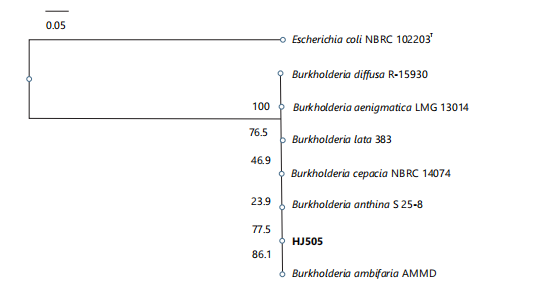
HJ505 molecular identification: Isolate HJ505 DNA was extracted, amplified and sequenced following Adam Dade et al.20 using the primers in Table S1. Sequence homology search was conducted with NCBI nucleotide BLAST tool20. The function "build" of ETE3 3.1.326 was used for alignment and phylogenetic reconstructions as applied on the GenomeNet. Phylogenetic tree was constructed using FastTree v2.1.8 with default parameters27. Escherichia coli, NBRC102203T was used as outgroup.
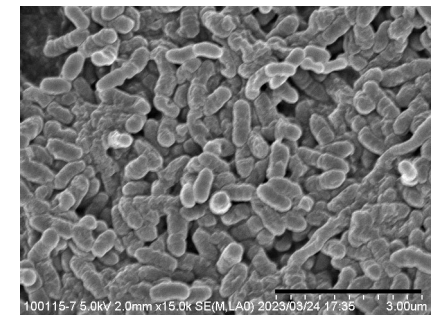
Scanning electron microscopy of HJ505: The sample of HJ505 was prepared and scanned under electron microscopy as described by Adam Dade et al.20.
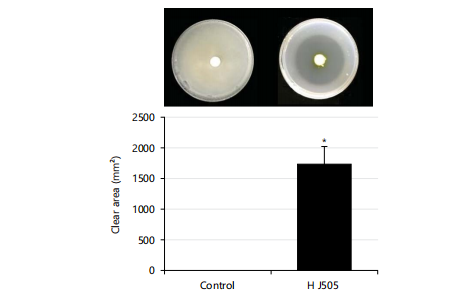
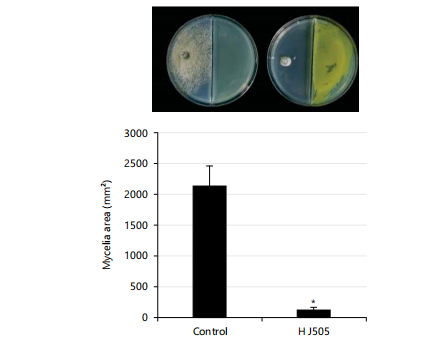
Proteolytic enzyme and volatile compounds production by HJ505: Protease enzyme production was evaluated on skim milk agar (SMA; 0.5% w/v skim milk powder and 1.5% w/v agar). An 8-mm-diameter paper disc (Advantec, Tokyo, Japan) placed in the center of the plate was inoculated either with 50 μL of HJ505 LB broth for the treatment, either with 50 μL of LB broth for the control. The clear area (mm2) on the SMA plates were measured after 7 days using LIA 32 software20. Treatment and control plates are replicated 5 times and the experiment was repeated 3 times. To evaluate the volatile compounds production, a two weeks old mycelium plug was placed on one side of a half divided plate containing PDA medium. For the treatment plate, an amount of 50 μL of isolate HJ505 LB broth was spread on the other side of the half divided plate and for the control plate, 50 μL of LB broth was spread on the other half. Treatment and control plates were replicated 4 times and the experiment was repeated 2 times. The plates were hermetically sealed with ParafilmTM to avoid volatile compounds leaking and were incubated at 26±2°C. The pathogen growth area was measured after 10 days using LIA 32 software20.
HJ505 growth promotion on seedlings and seeds: Tomato seedlings growth promotion experiment was conducted using a modified method20. An amount of 5 mL of HJ505 LB broth was dropped around the base of 21 days-old tomato seedlings on the soil. For the control, 5 mL of LB broth was used. Five plants were used per treatment, and the experiment was done three times. After 3 weeks, the dried weight of the shoots and roots of each 6 weeks-old plant was assessed. For the tomato seeds germination promotion experiment, 10 seeds were kept in culture tube containing HJ505 LB broth for 24 hrs at 140 rpm for treatment use and for the control, 10 seeds were kept in LB broth tube. Among the 10 seeds soaked, one was randomly selected and put 2 mm deeper in SDW-agar glass tube (1% w/v agar) for germination. Treatment and control plates were replicated 5 times and the experiment repeated 2 times. After 1 week, the length of each 7-day-old germinated seed was measured, and the seeds were oven-dried at 70°C until a constant mass to determine the dry weight.
Indole acetic acid (IAA) and siderophores production by HJ505: The production of IAA by HJ505 NB broth and filtrate was evaluated using a modified method20,28. Isolate HJ505 LBA colonies were separately inoculated and grown in nutrient broth (NB; 0.5 % w/v peptone; 0.15% w/v yeast extract; 0.15% w/v beef extract; and 0.5% w/v NaCl) without and with 0.1% L-tryptophan (w/v). The cultures tubes were incubated for 4 days at 26±2°C, in a rotary shaker at 180 rpm and later centrifuged at 5500 rpm for 25 min to obtain the supernatant. For HJ505 NB broth, an amount of 1 mL supernatant was collected and mixed with 2 mL of Salkowski’s reagent and incubated for 30 min at 23±4°C. For the control, 1 mL of NB broth (with and without L-tryptophan) was mixed with the Salkowski’s reagent. For HJ505 NB broth filtrate, the supernatant was filtered through a 0.22-μm pores and 1 mL was mixed with 2 mL of Salkowski’s reagent and for the broth filtrate control, 1 mL of NB broth filtered through a 0.22-μm pores was mixed with 2 mL of Salkowski’s reagent (with and without L-tryptophan). A spectrometer (UV mini-1240: photometric mode, Shimandzu Co., Kyoto, Japan) was used for absorption measurement at 530 nm. The absorption data of pure 3-Indoleacetic acid standards (Wako Chemical Pure Industries Ltd, Osaka, Japan) set at 5, 10, 20, 50, and 100 μg/mL served as base to assess IAA production using a regression line29. Treatments and control were repeated in 5 culture tubes and the experiment was repeated twice. To evaluate HJ505 siderophores production, modified chrome azurol S (CAS) based on a competition for Fe3+ between the siderophores and the ferric complex of the Dye CAS was used30. For the Blue Dye preparation, fours solutions named 1, 2, 3 and 4 were made. For solution 1, CAS Mordant Blue 29 (0.0605 g) was dissolved in 50 mL of distilled water (DW). For the solution 2, FeCl3-6H2O (0.027 g) and 6N HCl (167 μl) were dissolved in 100 mL of DW. For the solution 3, hexadecyl trimethyl ammonium bromide: HDTMA (0.0729 g) was dissolved in 40 mL of DW. And finally for the solution 4, PIPES-Na (3 g), glucose (2 g) and agar (3 g) were dissolved in 90 mL of N11 medium. To prepare N11 medium, NaNo3 (0.27 g), K2HPO4 (0.01 g), MgSO4 (0.045 g), KCl (0.045 g) and FeSO4 (0.0009 g) were dissolved in 90 mL of DW. A respective volume of 5, 1 and 4 mL of solution 1, 2 and 3 were mixed and autoclaved separately with solution 4. After autoclave, the two sterilized solutions were mixed and poured in 7 cm diameter petri plates. HJ505 LB broth drops of 10 μL were placed at four random positions on the CAS medium plates. For the control four drops of 10 μL of LB broth were applied. Treatment and control plates were repeated 3 times and incubated at 26±2°C. After 4 days the orange-yellow coloration area around each spots was measured using LIA 32 software20. The experiment was repeated twice.
HJ505 time-lapse sensitivity to salinity and pH variation: For the salinity test, 3 days old HJ505 on LBA was inoculated to LB broth tubes with NaCl concentration adjusted to 0.15 M, 0.3 M, 0.5 M, 1 M, 2 M and 0 M for the control. For the pH test, HJ505 on LBA was inoculated to LB broth tubes with a pH adjusted to 3, 4.2, 5.2, 7.95, 8.95 and 6.82 used as control. Treatments and controls were repeated in 5 tubes and incubated at 26±2°C, in a rotary shaker at 140 rpm. The OD600mn of each tube was recorded at 6, 12, 18, 24 hrs and the experiment was repeated twice.
Statistical analysis: Student’s t-test was used to evaluate significance difference in the means values between two groups’ data. For multiple groups’ analysis, Tukey’ Honest Significant Difference (HSD) test run after a one-way ANOVA. SPSS Statistics ver. 30.0 for Windows (IBM, Armonk, NY, USA) was used as statistical software. Data were presented as Mean±Standard Deviation (SD), and differences were considered significant at p<0.05.
RESULTS
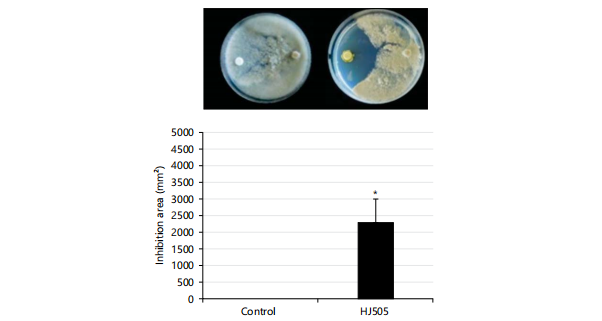
HJ505 inhibitory test by dual culture: The inhibition area measured with HJ505 treatment was significantly different compared to the control. The HJ505 induced an inhibition area of 2295.33±718.47 mm2 (Mean±SD) compared to the control which induced 0 mm2 (Fig. 1).
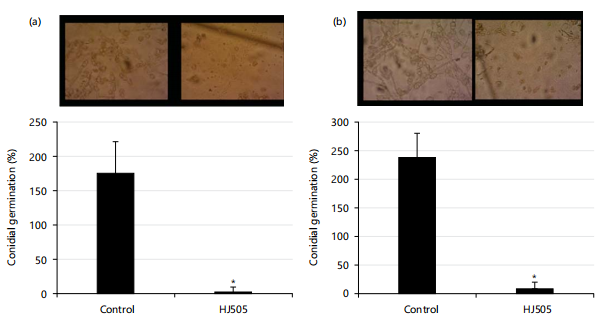
Inhibition of pathogen conidial germination by HJ505: Pathogen conidia germination evaluated in percentage was strongly and significantly inhibited by HJ505 LB broth and filtrate compared to the control (only LB broth). HJ505 LB broth induced only 3.33±6.95% (Mean±SD) germinated conidia compared to the control which induced 175.17±45.7% (Fig. 2a). The HJ505 LB broth filtrate in the other hand induced 9.67±9.57% compared to the control which induced 237.33±43.6% (Fig. 2b).
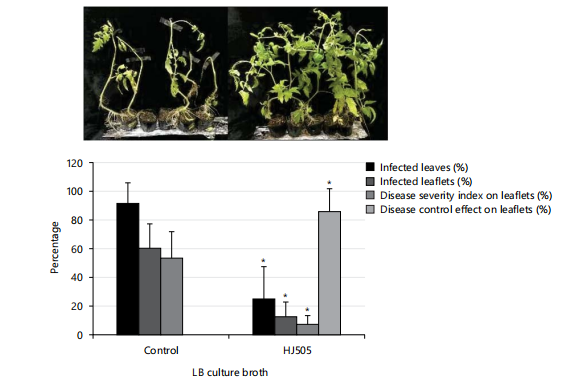
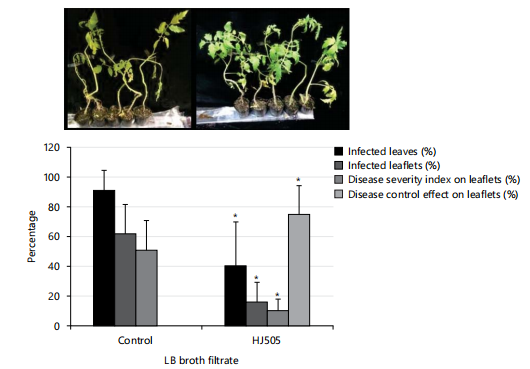
Pathogen infection reduction on tomato plant by HJ505: The HJ505 LB broth on home Momotaro cv. tomato leaves significantly reduced infection on leaves and leaflets. The percentages of infected leaves and leaflets induced by HJ505 LB broth were respectively 25.46±22.21 % (Mean±SD) and 12.49±10.48% compared to the control which induced respectively 91.67±14.43% and 60.65±16.81%. The disease severity index (DSI) and disease control effect (DCE) induced by HJ505 LB broth on the leaflets were respectively 7.03±6.49% and 86.13±15.82% compared to the control which induced respectively 55.54±18.61 and 0%. (Fig. 3). Using HJ505 broth filtrate, the percentages of infected leaves and leaflets induced were, respectively 40.11±29.57% and 15.97±13.02% compared to the control which induced respectively 91.22±13.34% and 62.62±19%. The DSI and DCE induced by HJ505 LB broth filtrate on the leaflets were respectively, 10.06±7.55 and 74.86±19.32% compared to the control which induced 50.56±19.89 and 0%. (Fig. 4).
|
|
|
HJ505 molecular identification: The HJ505 16S rDNA sequence analysis shared 99 % of similarity with Burkholderia ambifaria and the phylogenetic tree was constructed (Fig. 5). The 16S rDNA sequence has been deposited in the DDBJ/EMBL/GenBank database under accession number LC909675, with a full length of 1455 bp.
|
|
Scanning electron microscopy of HJ505: Burkholderia species, straight rod shaped, was confirmed after scanning HJ505 cells and the dividing process was observed. The size of the cell was approximately 0.3-0.5×0.6-1 μm (Fig. 6).
Proteolytic enzyme and volatile compounds production by HJ505: The HJ505 protease production was evaluated through the clear area around the disc paper inoculated with HJ505 LB broth. HJ505 induced a clear area of 1726.12±293.0 mm2 (Mean±SD) significantly different to the control which induced 0 mm2 (Fig. 7). The production of volatile compounds by HJ505 LB broth was also confirmed by observing pathogen mycelial growth inhibition. Mycelia area of pathogen after HJ505 inoculation was 125.04±43.26 mm2 compared to the control which induced 2147.29±321.46 mm2 (Fig. 8).
|
|
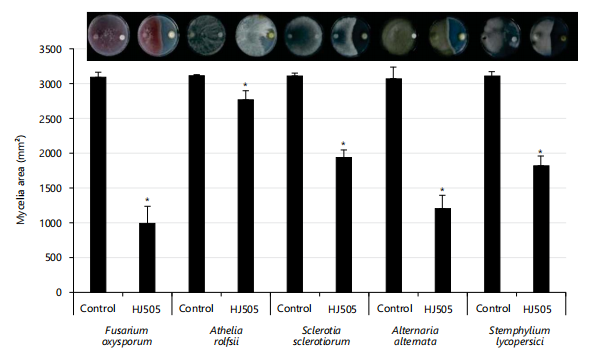
Inhibition of 5 others tomato fungal pathogens by HJ505: Isolate HJ505 PC1 broth significantly reduced 5 others tomato pathogen mycelia growth compared to the control. In the presence of HJ505 PC1 broth, the mycelia growth area of Fusarium oxysporum f. sp. Lycopersici, was 987.61±249.96 mm2 (Mean±SD) compared to the control (presence of PC1 broth only) which induced 3092.11±74.14 mm2. The mycelia growth area of Athelia rolfsii was 2767.67±132.01 mm2 compared to the control which induced 3119.83±10.67 mm2. The mycelia growth area of Sclerotinia sclerotiorum was 1936.14±108.14 mm2 compared to the control which induced 3113.51±35.95 mm2. The mycelia growth area of Alternaria alternata was 1204.59±195.92 mm2 compared to the control which induced 3071.44±168.10 mm2 and finally for Stemphylium lycopersici, the mycelia growth area was 1821.03±140.83 mm2 compared to the control which induced 3103.39±67.95 mm2 (Fig. 9).
|
|
|
|
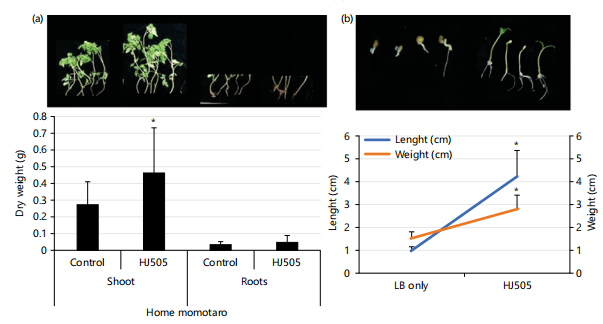
HJ505 growth promotion on seedlings and seeds: The growth promotion of HJ505 LB broth on tomato home Momotaro cv. seedlings was more effective on leaves than roots. On the leaves, the dry weight induced was 0.46±0.27 g (Mean±SD) significantly different to the control (only LB broth) which induced 0.27±0.13 g. On the roots, the dried weight induced 0.05±0.04 g and was not significantly different to the
control which induced 0.03±0.02 g (Fig. 10a). The seeds germination and growth were also highly promoted by HJ505 LB broth. The length induced are 4.24±1.11 cm significantly different to the control which induced 0.98±0.17 cm and the weight induced are 2.8±0.61 mg significantly different to the control which induced 1.51±0.29 mg (Fig. 10b).
| Table 1: | IAA production by isolate HJ505 LB broth | |||
| Treatments | IAA values ppm |
| Control | 0.00±0.00a |
| HJ505 without tryptophan | 33.67±5.20b |
| HJ505 with tryptophan | 92.78±2.47c |
| Values represent were Mean±SD and Different letters within a column indicate significant difference (Tukey HSD test, p<0.05) | |
| Table 2: | IAA production by isolate HJ505 LB broth filtrate | |||
| Treatments | IAA values ppm |
| Control | 0.00±0.00a |
| HJ505 without tryptophan | 0.00±0.00a |
| HJ505 with tryptophan | 19.91±2.74b |
| Values represent were Mean±SD and Different letters within a column indicate significant difference (Tukey HSD test, p<0.05) | |
| Table 3: | Isolate HJ505 sensitivity to salinity timelapse in cell optical density (OD600) | |||
| NaCl | ||||||
| Hours | 0 M | 0.15 M | 0.3 M | 0.5 M | 1 M | 2 M |
| HJ505 (OD600), (mean±SD) | ||||||
| 6 | 0.56±0.08 | 0.58±0.06 | 0.47±0.06 | 0.48±0.07 | 0.33±0.06 | 0.03±0.01 |
| 12 | 1.67±0.11 | 1.79±0.09 | 1.19±0.26 | 0.41±0.25 | 0.17±0.08 | 0.03±0.01 |
| 18 | 2.09±0.03 | 2.08±0.04 | 2.09±0.03 | 1.75±0.15 | 0.77±0.1 | 0.03±0.01 |
| 24 | 2.09±0.03 | 2.09±0.03 | 2.09±0.03 | 1.62±0.13 | 0.24±0.1 | 0.03±0.01 |
| Table 4: | Isolate HJ505 sensitivity to pH timelapse in cell optical density (OD600) | |||
| pH | ||||||
| Hours | 6.82 | 3 | 4.2 | 5.2 | 7.95 | 8.95 |
| HJ505 (OD600), (mean±SD) | ||||||
| 6 | 0.9±0.19 | 0.23±0.08 | 0.54±0.1 | 0.76±0.07 | 0.31±0.04 | 0.57±0.06 |
| 12 | 1.69±0.12 | 0.33±0.8 | 0.66±0.1 | 1.8±0.15 | 0.67±0.15 | 0.27±0.25 |
| 18 | 2.07±0.05 | 0.16±0.05 | 1.02±0.28 | 2.09±0.03 | 1.15±0.51 | 0.35±0.14 |
| 24 | 2.08±0.04 | 0.03±0.03 | 2.09±0.03 | 2.08±0.04 | 2.09±0.03 | 0.02±0.01 |
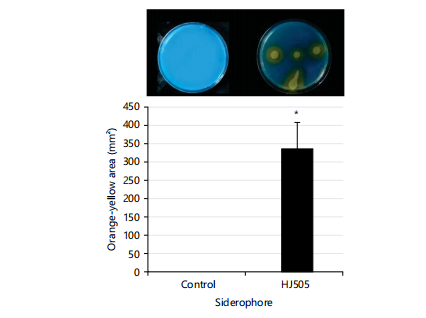
Indole acetic acid (IAA) and siderophores production by HJ505: HJ505 NB broth IAA production was doubled with tryptophan. The HJ505 NB broth without tryptophan produced 33.67±5.20 ppm (Mean±SD) significantly different to 0 ppm for the control (only NB broth) and HJ505 NB broth with tryptophan produced 92.78±2.47 ppm significantly different to 0 ppm for the control (only NB broth with tryptophan). The statistical analysis are presented in the Table 1. For HJ505 NB broth filtrate, IAA was low with tryptophan and was not produced without. The HJ505 NB broth filtrate with tryptophan produced 19.91±2.74 ppm significantly different to 0 ppm for the control (only NB broth filtrate with tryptophan) and without tryptophan, HJ505 NB broth filtrate produced 0 ppm compared to 0 ppm for the control (only NB broth filtrate). The statistical results are presented in Table 2. As for siderophores production, isolate HJ505 LB broth induced an orange-yellow coloration area of 336.09±70.85 mm2 significantly different to 0 mm2 for the control (Fig. 11).
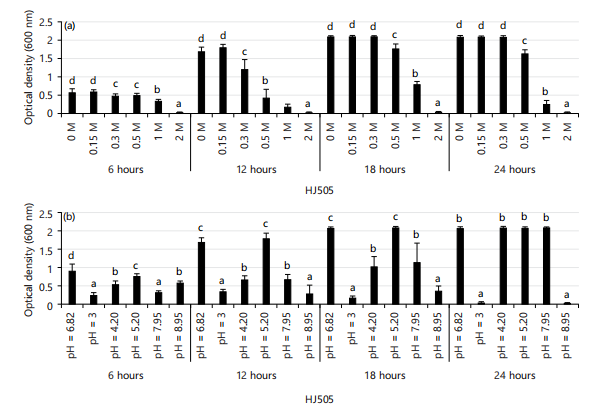
HJ505 timelapse sensitivity to salinity and pH variation: The sensitivity to salinity and pH variation data of isolate HJ505 in LB broth are presented in Table 3 and Table 4. As for the salinity sensitivity, HJ505 in LB broth at 0 M of NaCl was considered as control. HJ505 in LB broth at 0.15 M, at 0.3 M of NaCl and the control presented a linear growth and reached their maximal growth expressed in cells density (OD600>2) at 18 hrs after inoculation (Table 3). At this same duration, the growth of HJ505 in LB broth at 0.5 M of NaCl, was slightly lower compared to the control and significantly different. From 6 to 24 hrs after inoculation, the growth of HJ505 in LB broth at 1 M of NaCl was very low, significantly different to the control and no growth was recorded at 2 M (Fig. 12a). As for the pH sensitivity, HJ505 in LB broth with a pH of 6.82 was considered as control and had its maximal growth expressed in cell density (OD600>2) at 18 hrs after inoculation (Table 4). Similar to the control, only HJ505 in LB broth with a pH of 5.2 reached its maximal growth at 18 hrs after inoculation (OD600>2). HJ505 in LB broth with a pH of 4.2 and 7.95 had a lower growth significantly different to the control and finally reached their maximal growth at 24 hrs after inoculation (OD600>2). At a pH of 3 and 8.95, HJ505 growth was constantly low from 6 to 18 hrs after inoculation and no growth was recorded at 24 hrs after inoculation. (Fig. 12b).
|
DISCUSSION
Control strategies against plant pathogenic fungi mainly involve the use of chemical fungicides which has led to development of resistance to these chemicals31. Therefore, it is necessary to develop a sustainable way of disease management like the use of microbial fungicides which are safe and environment friendly32. The rod shaped of microbial fungicide Burkholderia ambifaria HJ505 scanned in this study was similar to same genus Burkholderia gladioli strain KRS02719. In this study, Burkholderia ambifaria inhibitory effect on pathogen Botrytis cinerea mycelia growth is not yet reported. However same genus Burkholderia gladioli19 and Burkholderia plantarii BpMS9033 inhibitory on Botrytis cinerea mycelia growth was confirmed. The biocontrol and reduction of Botrytis cinerea necrotic lesions on tomato leaves by Burkholderia ambifaria has not yet been reported however cepacin metabolite produced by Burkholderia ambifaria has been identified to be responsible of Burkholderia ambifaria antagonistic potential against pathogens17. Same genus, Burkholderia plantarii BpMS90 has been reported inhibiting Botrytis cinerea symptoms on tomato fruits and 10 others plant pathogens in vitro33 aligning with various fungal pathogen inhibited by HJ505 in this study. About the growth promotion of isolate HJ505 this is the first growth promotion report of Burkholderia ambifaria on tomato. However, the growth promotion of barley seedlings34 and wheat35 by Burkholderia ambifaria T16 was confirmed through various metabolites like IAA, siderophores, phosphate-solubilization, 1-aminocyclopropane-1-carboxylate. It has been demonstrated that Burkholderia ambifaria produced many structures of siderophores such as PCH, ornibactin (with antimicrobial properties), malleobactin, cepaciachelin, azurechelin and cepabactin14. These capacity of siderophores production can allow Burkholderia sp to survive in iron deficient environment. Another specie, Burkholderia gladioli strain KRS027 also produced siderophores, protease and inhibited pathogen Botrytis cinerea with its volatile compounds19. Burkholderia ambifaria strain H8 was also reported to inhibit pathogen Fusarium graminearum causing maize stalk through its volatile compounds dimethyl disulfide36 aligning with HJ505 volatile compounds secretion confirmed in the present study. Burkholderia ambifaria strain T16 has been reported degrading fusaric acid mycotoxin produced by Fusarium species pathogen causing wilts and root rot diseases on variety of plants and also reducing disease infection on the barley seedlings plant34. Furthermore, Bacillus spp. and Pseudomonas spp., well known biocontrol agents, have failed to degrade fusaric acid mycotoxin confirming the strong antifungal properties of Burkholderia ambifaria HJ505 in the reduction of gray mold infection on tomato leaves in this study. The tolerance of Burkholderia ambifaria to low pH has also been demonstrated34,37 and it was suggested that its use as probiotic could contribute to human health management. This study confirmed the possible use of HJ505 in West-African ecosystem characterized by warm and humid climates as well as various acid and saline soils. Furthermore, the stability of isolate HJ505 to temperature, pH and salinity is a significant advantage favoring its validation and commercialization as new biopesticide. In conclusion, Burkholderia ambifaria strain HJ505 has the potential to become a good biocontrol agent, and contribute to the development of a new microbial fungicide to prevent tomato gray mold caused by Botrytis cinerea. This study aligned with the findings of Adam Dade et al.20 as research conducted in Japan and using soil ecosystem microbes for a sustainable control of diseases seen as a threat in West-African agriculture. It’s also the first report on Burkholderia ambifaria inhibitory effect on Botrytis cinerea gray mold on tomato leaves.
CONCLUSION
This study investigated the biocontrol and growth-promoting potential of soil bacterial isolate HJ505 against tomato gray mold pathogen Botrytis cinerea using accessible methods to identify isolate HJ505 from cultivated soil; evaluate its inhibitory activity both in vitro and in planta; determine its scientific identity; assess its plant growth–promoting properties; identify primary and secondary metabolites involved in biocontrol and growth promotion and examine isolate HJ505 sensitivity to environmental factors specific for future application from Japan to West-Africa. This study could encourage African researchers, particularly in West Africa, to conduct more identification and characterization studies on local soil microbial isolates with biocontrol and growth-enhancing potential. These efforts will facilitate the selection of the most promising biocontrol agent for developing affordable antagonist-based biopesticides.
SIGNIFICANCE STATEMENT
This study is in phase with the second and third sustainable development goals aiming zero hunger, good health and well-being particularly in underdeveloped countries. A low-cost sustainable management of cultured plant diseases and fertilization using natural bioresources like soil microbes is a key point to reduce in the short term and stop in the long term the use of chemical pesticides and fertilizers. This study results highlighted the inhibitory potential of Japan soil bacteria Burkholderia ambifaria HJ505 against pathogen Botrytis cinerea seen as threat in West-Africa tomato production. It has also highlighted the significant promotion effect on tomato seed germination and seedling growth. As a previous step to its application in West-Africa, the tolerance of Japan isolate HJ505 to salinity and acidy very common in West-African soils confirmed the possible use in others agroecosystems. This study presented a set of useful methods for beneficial local soil microbes’ isolation and evaluation for inhibitory and growth promotion potential.
REFERENCES
- Ray, D.K., N. Ramankutty, N.D. Mueller, P.C. West and J.A. Foley, 2012. Recent patterns of crop yield growth and stagnation. Nat. Commun., 3.
- Chiaka, J.C., L. Zhen and Y. Xiao, 2022. Changing food consumption patterns and land requirements for food in the six geopolitical zones in Nigeria. Foods, 11.
- Ajenifujah-Solebo, S.O., P.E. Akin-Idowu, A.O. Aduloju, V.O. Adedeji and E.T. Akinyode et al., 2025. Tomato Crop Improvement Efforts in Nigeria: Past, Current and Future Perspectives. In: Solanum lycopersicum L.-Research Methods, Approaches, and Perspectives, Rekoslavskaya, N. and W.J. Grichar (Eds.), IntechOpen, London, United Kingdom.
- Oluchukwu, D.J., M.L. Ozoemene, D.N. Chidimma and O.O. Happiness, 2025. Climate variability and its effect on tomato yield in Nigeria. Int. J. Multidiscip. Res. Growth Eval., 6: 635-643.
- Asare-Addo, D.C., J.N. Amissah, P.A. Ofori, S. Owusu-Nketia, F. Opoku-Agyemang and G.O. Nkansah, 2022. Evaluation of agronomic performances and fruit quality of improved tomato (Solanum lycopersicum L.) lines under greenhouse conditions. J. Agric. Food Res., 9.
- Dik, A.J. and Y. Elad, 1999. Comparison of antagonists of Botrytis cinerea in greenhouse-grown cucumber and tomato under different climatic conditions. Eur. J. Plant Pathol., 105: 123-137.
- Fletcher, J., C. Bender, B. Budowle, W.T. Cobb and S.E. Gold et al., 2006. Plant pathogen forensics: Capabilities, needs, and recommendations. Microbiol. Mol. Biol. Rev., 70: 450-471.
- Kretchmer, M. and M. Hahn, 2008. Fungicide resistance and genetic diversity of Botrytis cinerea isolates from a vineyard in Germany. J. Plant Dis. Prot., 115: 214-219.
- de Miccolis Angelini, R.M., S. Pollastro and F. Faretra, 2015. Genetics of Botrytis cinerea. In: Botrytis-The Fungus, the Pathogen and its Management in Agricultural Systems, Fillinger, S. and Y. Elad (Eds.), Springer International Publishing, Switzerland, ISBN: 978-3-319-23371-0, pp: 35-53.
- Kim, Y.K. and C.L. Xiao, 2011. Stability and fitness of pyraclostrobin- and boscalid-resistant phenotypes in field isolates of Botrytis cinerea from apple. Phytopathology, 101: 1385-1391.
- Ally, N.M., H. Neetoo, V.M. Ranghoo-Sanmukhiya, S. Hardowar and V. Vally et al., 2021. First report of Botrytis cinerea causing gray mold on greenhouse-grown tomato plants in Mauritius. Plant Dis., 105: 2725-2725.
- Zhao, X., M. Chen, H. Mao, C. Zhang and J. Wu, 2024. Genetic structure and pyrimethanil resistance of Botrytis spp. causing gray mold on strawberry from greenhouses in Zhejiang, China. Pestic. Biochem. Physiol., 205.
- Roman, D.L., D.I. Voiculescu, M. Filip, V. Ostafe and A. Isvoran, 2021. Effects of triazole fungicides on soil microbiota and on the activities of enzymes found in soil: A review. Agriculture, 11.
- Afonso, L., B. Gionco-Cano, A.S. Simionato, E.T.G. Niekawa and G.E.A. Pega et al., 2021. Microbial Bioactive Compounds in Plant Disease Management. In: Food Security and Plant Disease Management, Kumar, A. and S. Droby, Elsevier, Amsterdam, Netherlands, ISBN: 978-0-12-821843-3, pp: 37-61.
- Takeuchi, T., H. Sawada, F. Suzuki and I. Matsuda, 1997. Specific detection of Burkholderia plantarii and B. glumae by PCR using primers selected from the 16S-23S rDNA spacer regions. Jpn. J. Phytopathol., 63: 455-462.
- Coenye, T. and P. Vandamme, 2003. Diversity and significance of Burkholderia species occupying diverse ecological niches. Environ. Microbiol., 5: 719-729.
- Mullins, A.J., J.A.H. Murray, M.J. Bull, M. Jenner and C. Jones et al., 2019. Genome mining identifies cepacin as a plant-protective metabolite of the biopesticidal bacterium Burkholderia ambifaria. Nat. Microbiol., 4: 996-1005.
- Lin, Z., J.O. Falkinham, K.A. Tawfik, P. Jeffs and B. Bray et al., 2012. Burkholdines from Burkholderia ambifaria: Antifungal agents and possible virulence factors. J. Nat. Prod., 75: 1518-1523.
- Wang, D., W.Z. Luo, D.D. Zhang, R. Li and Z.Q. Kong et al., 2023. Insights into the biocontrol function of a Burkholderia gladioli strain against Botrytis cinerea. Microbiol. Spectrum, 11.
- Dade, G.M.A.A., J. Kihara and M. Ueno, 2023. Control of tomato Southern blight caused by Athelia rolfsii (syn. Sclerotium rolfsii) using the soil isolate Streptomyces sasae strain GT4041. J. Gen. Plant Pathol., 89: 159-169.
- Lemtukei, D., T. Tamura, T.Q. Nguyen, J. Kihara and M. Ueno, 2016. Antagonistic potential of isolated microorganisms from soil in Shimane prefecture against rice blast disease cause by Magnaporthe oryzae. Bull. Fac. Life Environ. Sci. Shimane Univ., 21: 9-12.
- Moriguchi, Y., J. Kihara and M. Ueno, 2019. Suppression effects of a secondary metabolite of Biscogniauxia sp. strain O-811 obtained from mushrooms against the rice blast fungus Magnaporthe oryzae. Bull. Fac. Life Environ. Sci. Shimane Univ., 24: 14-18.
- Zerdoner, M., S. Gabriëls, P. Arens, R.G.F. Visser and P. Mishra, 2025. Detection of Botrytis cinerea severity in rose petals using hyperspectral imaging for plant breeding applications. Comput. Electron. Agric., 233.
- Segarra, G., G. Santpere, G. Elena and I. Trillas, 2013. Enhanced Botrytis cinerea resistance of Arabidopsis plants grown in compost may be explained by increased expression of defense-related genes, as revealed by microarray analysis. PLoS ONE, 8.
- Gupta, D.R., S.K. Paul, M. Ino, Y. Oowatari and M. Ueno, 2025. Bacillus safensis NI2B displays strong antagonistic activities against rice blast pathogen Pyricularia oryzae through the production of volatile compounds. Phytopathol. Res., 7.
- Huerta-Cepas, J., F. Serra and P. Bork, 2016. ETE 3: Reconstruction, analysis, and visualization of phylogenomic data. Mol. Biol. E, 33: 1635-1638.
- Price, M.N., P.S. Dehal and A.P. Arkin, 2010. FastTree 2-approximately maximum-likelihood trees for large alignments. PLoS ONE, 5.
- Gordon, S.A. and R.P. Weber, 1951. Colorimetric estimation of indoleacetic acid. Plant Physiol., 26: 192-195.
- Patten, C.L. and B.R. Glick, 2002. Role of Pseudomonas putida indoleacetic acid in development of the host plant root system. Appl. Environ. Microbiol., 68: 3795-3801.
- Schwyn, B. and J.B. Neilands, 1987. Universal chemical assay for the detection and determination of siderophores. Anal. Biochem., 160: 47-56.
- Yin, Y., J. Miao, W. Shao, X. Liu, Y. Zhao and Z. Ma, 2023. Fungicide resistance: Progress in understanding mechanism, monitoring, and management. Phytopathology, 113: 707-718.
- Ayilara, M.S., B.S. Adeleke, S.A. Akinola, C.A. Fayose and U.T. Adeyemi et al., 2023. Biopesticides as a promising alternative to synthetic pesticides: A case for microbial pesticides, phytopesticides, and nanobiopesticides. Front. Microbiol., 14.
- Xie, K., Y. Du, X. Gan, J. Zhang and X. Liu et al., 2025. Endophytic Burkholderia plantarii BpMS90 protects harvested tomato against gray mold via antagonistic action and disease resistance induction. Chem. Biol. Technol. Agric., 12.
- Simonetti, E., I.N. Roberts, M.S. Montecchia, F.H. Gutierrez-Boem, F.M. Gomez and J.A. Ruiz, 2017. A novel Burkholderia ambifaria strain able to degrade the mycotoxin fusaric acid and to inhibit Fusarium spp. growth. Microbiol. Res., 206: 50-59.
- An, C., S. Ma, C. Liu, H. Ding and W. Xue, 2022. Burkholderia ambifaria XN08: A plant growth-promoting endophytic bacterium with biocontrol potential against sharp eyespot in wheat. Front. Microbiol., 13.
- Chen, X., J. Liu, A.J. Chen, L. Wang and X. Jiang et al., 2024. Burkholderia ambifaria H8 as an effective biocontrol strain against maize stalk rot via producing volatile dimethyl disulfide. Pest. Manage. Sci., 80: 4125-4136.
- Chen, Z., Y. Lu, Z. Xu, L. Wu, X. Wei and Y. Cai, 2024. Evaluation of a Burkholderia ambifaria strain from plants as a novel promising probiotic in dental caries management. J. Oral Microbiol., 16.
- Huong, N.L., K. Itoh and K. Suyama, 2007. Diversity of 2,4-dichlorophenoxyacetic acid (2,4-D) and 2,4,5-trichlorophenoxyacetic acid (2,4,5-T)-degrading bacteria in Vietnamese soils. Microbes Environ., 22: 243-256.
- Matsui, T., K. Kato, T. Namihira, N. Shinzato and H. Semba, 2009. Stereospecific degradation of phenylsuccinate by actinomycetes. Chemosphere, 76: 1278-1278.
- Lanoot, B., M. Vancanneyt, B. Hoste, K. Vandemeulebroecke and M.C. Cnockaert et al., 2005. Grouping of streptomycetes using 16S-ITS RFLP fingerprinting. Res. Microbiol., 156: 755-762.
SUPPLEMENTARY DATA
| Table S1 | The sequence of Primers used for the isolate HJ505 molecular identification. | |||
| Primers | Sequence (5’ → 3’) | Reference |
| fD1 | AGAGTTTGATCCTGGCTCAG | Huong et al.38 |
| rP2 | ACGGCTACCTTGTTACGACTT | Huong et al.38 |
| EUB906F | AAACTCAAAGGAATTGRCGG | Matsui et al.39 |
| EUB532R | CACGGTCGKCGGCGCCATT | Matsui et al.39 |
| 1115R | GTTGCTCGCGTTGGGA | Lanoot et al.40 |
| 802R | CCTAATCTATGGGACCAT | Lanoot et al.40 |
| 926F | AAACTCAAAGGAATTGACGG | Lanoot et al.40 |
| 785F | GGATTAGATACCCTGGTAGTC | Lanoot et al.40 |
| 536R | GTCGTCGGCGCCATTATG | Lanoot et al.40 |
How to Cite this paper?
APA-7 Style
Adam Dade,
G.M., Ueno,
M. (2026). Biocontrol of Botrytis cinerea on Tomato Leaves and Growth Promotion Potential of Soil Isolate HJ505 (Burkholderia ambifaria). Asian Journal of Plant Pathology, 20(1), 12-17. https://doi.org/10.3923/ajpp.2026.12.17
ACS Style
Adam Dade,
G.M.; Ueno,
M. Biocontrol of Botrytis cinerea on Tomato Leaves and Growth Promotion Potential of Soil Isolate HJ505 (Burkholderia ambifaria). Asian J. Plant Pathol. 2026, 20, 12-17. https://doi.org/10.3923/ajpp.2026.12.17
AMA Style
Adam Dade
GM, Ueno
M. Biocontrol of Botrytis cinerea on Tomato Leaves and Growth Promotion Potential of Soil Isolate HJ505 (Burkholderia ambifaria). Asian Journal of Plant Pathology. 2026; 20(1): 12-17. https://doi.org/10.3923/ajpp.2026.12.17
Chicago/Turabian Style
Adam Dade, Gasta, Mouka Adechina, and Makoto Ueno.
2026. "Biocontrol of Botrytis cinerea on Tomato Leaves and Growth Promotion Potential of Soil Isolate HJ505 (Burkholderia ambifaria)" Asian Journal of Plant Pathology 20, no. 1: 12-17. https://doi.org/10.3923/ajpp.2026.12.17

This work is licensed under a Creative Commons Attribution 4.0 International License.